- This event has passed.
Anna Ridler: A Perfect Language of Images
25 April to 31 August
About Anna Ridler: A Perfect Language of Images
Anna Ridler is an artist whose work explores the creative and societal possibilities of artificial intelligence, often through self-built datasets that question how knowledge is constructed, classified, and shared.
An Oxford University alumna, her work has been exhibited internationally at institutions including the V&A and the Centre Pompidou, and she has been recognised by Ars Electronica and Artnet as one of nine pioneering artists working with AI.
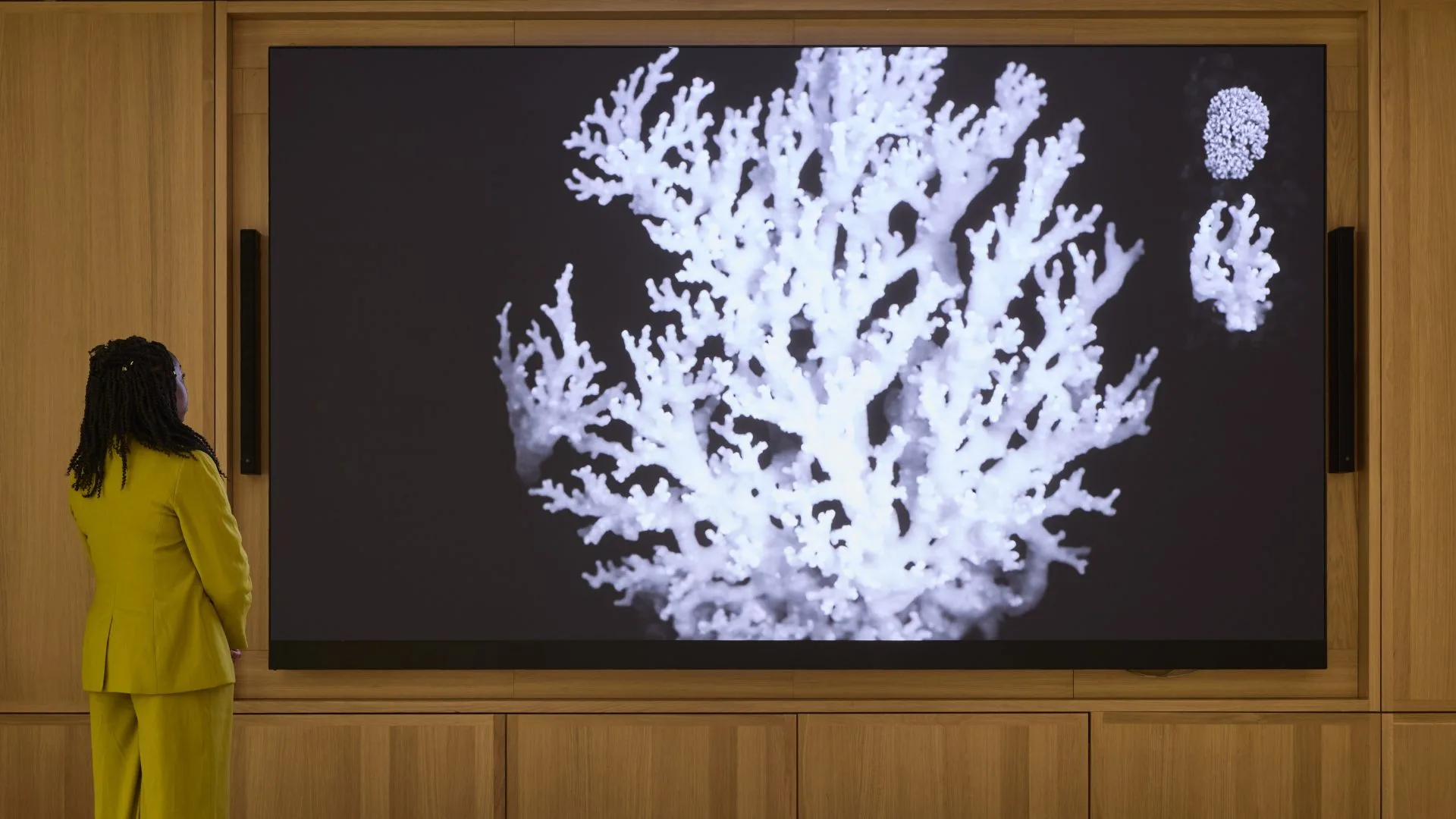
The digital artwork, created in collaboration with Dr William Poole from the Faculty of English at the University of Oxford, brings together three pieces by Ridler under the title A Perfect Language of Images.
It is inspired by Oxford scholar John Wilkins’ 1668 attempt to classify the world through a universal philosophical language, and Jorge Luis Borges’ later critique of such systems as inherently incomplete and unstable.
Drawing these ideas into conversation with contemporary machine learning, the work reflects on how generative systems inherit the same ambition towards totalising order, while continually revealing its limits.
In doing so, Ridler’s installation exposes the tension between classification and complexity, highlighting what can be approximated, what resists categorisation, and what ultimately escapes representation.
A Catalogue of Exceptions shows some of the things that strain or fail to fit within Wilkins’ taxonomy. Throughout the system there are acknowledged difficulties; organisms that are “imperfect”, “strange originals” and things suspended in “betwixt” categories: coral that is neither mineral nor plant, fungi that “seem to want” essential parts, zoophytes suspended between kingdoms.
Created using roughly a decade of different generative systems (2016–2025), each with its own unique aesthetic, and trained on imagery drawn from Wilkins’ own descriptions, it becomes almost a cabinet of curiosities, even as the logic that links each image remains unstable or not immediately legible.
Between Things displays Wilkins’ phrases as evidence of classification under pressure—instances where his system hesitates, hedges, and cannot decide. Handwritten text is rendered large and placed into the environment as a record of doubt, but one that is only visible at 3am, for an hour.
An Infinity of Lists assembles Wilkins’ language itself, showing every word used in his system, first mapped to the hierarchy he imposed, then gradually reframed through the logic of word2vec.
Over the duration of the work the mapping shifts from the symbolic architecture of Wilkins’ invented order toward statistical relations in learned embedding space. The piece flutters between word, image, and symbol, making visible how translation across systems and across time changes what counts as related.
Tickets
Please see important booking information below.
Booking information
Dates & times:
Open daily. No booking needed.
Location:
Great Hall
About Schwarzman Centre for the Humanities
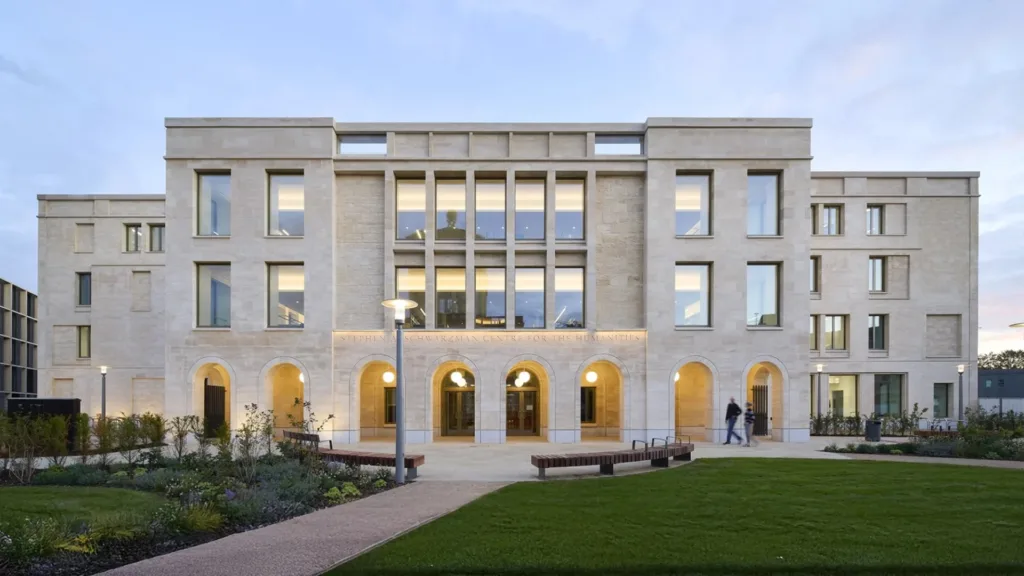
Schwarzman Centre for the Humanities is a major new cultural and academic landmark for the University of Oxford, bringing together seven humanities faculties with performance, exhibition, and public engagement spaces under one roof. Located in the Radcliffe Observatory Quarter, it is designed to foster interdisciplinary collaboration while opening the humanities to a wider public through events, performances, and year-round programming.
At its heart are world-class venues including a concert hall, theatre, cinema, recital spaces, and galleries, supported by flexible teaching and meeting facilities. A central atrium acts as a social hub, blending academic life with informal gathering spaces, cafés, and exhibitions. More than a university facility, the Centre functions as a civic cultural destination, connecting scholarship with creative practice and strengthening Oxford’s wider cultural life.