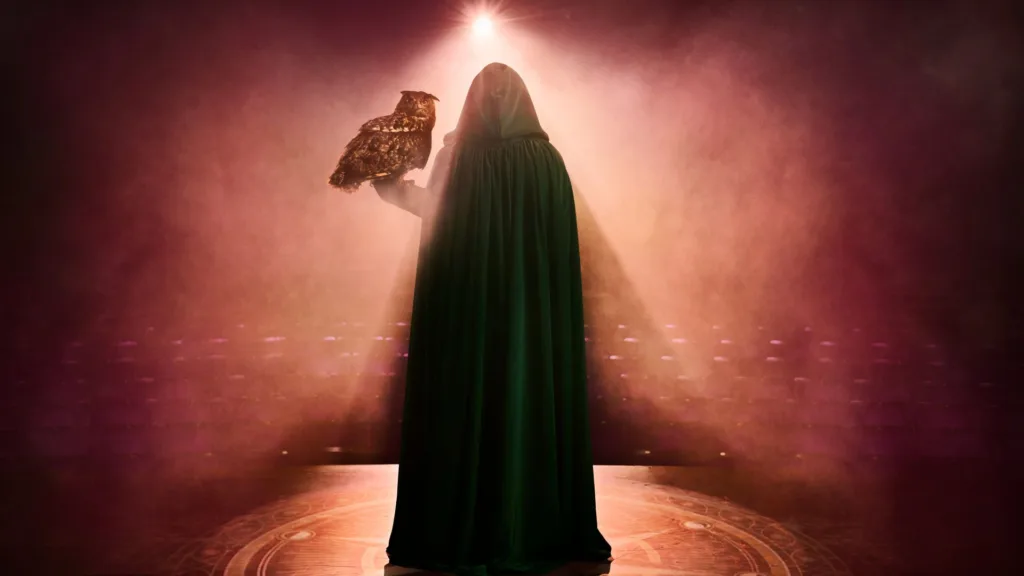
A woman’s life became the raw material for one of theatre’s most celebrated plays. Breach Theatre’s Burning Down the House, staged at the Schwarzman Centre in Oxford, revisited the relationship between Henrik Ibsen and Laura Kieler, raising questions about artistic appropriation, historical perspective and the power to decide whose stories endure.
In 1879, Henrik Ibsen unveiled A Doll’s House, a play that would become one of the defining works of modern theatre. Its heroine, Nora Helmer, leaves her husband and children in a dramatic rejection of the domestic conventions governing women’s lives. The play challenged audiences to reconsider marriage, individual freedom and the price of social conformity.
But what if the story behind this celebrated work belonged, in part, to someone else?
Laura Kieler was a young writer who had developed a relationship with Ibsen after he took an interest in her literary work. She turned to him for help during a personal and financial crisis, only to recognise elements of her own circumstances in his fiction. As Ibsen’s reputation grew, Kieler faced the consequences of a private history becoming public material. She subsequently wrote Men of Honour, a theatrical response to the appropriation of her experience.
It is this collision between literary achievement and personal cost that animates Burning Down the House, written by Ellice Stevens and Billy Barrett, directed by Barrett and devised with the cast. The production brings Kieler out from behind Nora’s shadow, asking what happens when the person who supplies the story is not the person who receives the credit.
The question extends well beyond nineteenth-century Scandinavia. It reaches into the ethics of biography, the commercial machinery of contemporary culture and the assumptions through which history is written. It also presents an uncomfortable challenge to the production itself: in attempting to restore Kieler’s voice, how does a modern company avoid imposing another interpretation on a woman whose life has already been repeatedly interpreted by others?
The thin line between inspiration and exploitation
Art has always borrowed from life. Writers draw on personal relationships, artists absorb the visual languages of other cultures, and playwrights transform real events into dramatic conflicts. Without that exchange, much of the creative world would be impoverished.
But the freedom to take inspiration from another person does not automatically settle the question of what is owed to them.
Ibsen was an established literary figure whose work would acquire international significance. Kieler was a writer, too, but her association with A Doll’s House has historically been far less prominent than his authorship of it. The imbalance is not simply a question of who had the better idea. It concerns who had the authority to transform experience into art, whose version reached the public and who bore the consequences.
Consider the fashion industry, where luxury brands have drawn on the textiles, motifs and craftsmanship of Indigenous and other culturally distinct communities. When those influences are commercialised without meaningful acknowledgement, consent or compensation, the language of inspiration can become a convenient defence for extracting value from someone else’s cultural inheritance.
The comparison is not exact: an individual’s private experience is not the same as a community’s collective cultural knowledge. Yet both cases expose a familiar asymmetry. The person or institution with the resources to transform an idea into a commercially successful product may be far better positioned to benefit from it than the people whose knowledge or experience made it possible.
Is the act creative simply because the finished work is original? Does artistic merit excuse the appropriation of its source? And if the source is acknowledged, is that sufficient, or should the original contributor share in the rewards?
Burning Down the House does not allow the question to remain comfortably abstract. Kieler’s circumstances give it a human cost: the distinction between having one’s life turned into art and having control over how that life is represented.
There is a danger, however, in reducing the relationship to a familiar morality tale in which the powerful man takes and the powerless woman suffers. The production’s own programme resists a straightforward division between villain and victim, describing two intelligent, flawed adversaries. That complexity matters. The ethical problem is not necessarily that artists should never draw on other lives, but that creative freedom does not remove the responsibility to consider the consequences.
Nor does giving Kieler a stage settle the matter. Her story is now being interpreted by Stevens and Barrett, performed by actors and framed by research. A woman once transformed into another writer’s fictional character has become the subject of a new work. The circumstances have changed, but the process of turning life into drama continues.
Who gets to write the historical record?
The production’s most enduring question may be less about whether Ibsen borrowed from Kieler than about how stories acquire authority.
Every narrative involves selection. Some events are emphasised; others disappear. One character’s motivations are explained, while another’s actions are left open to judgement. A person may be presented as courageous or reckless, sympathetic or manipulative, depending on which details are foregrounded and which remain outside the frame.
Such choices need not amount to deliberate deception. A writer can be sincere and still produce a partial account. Artistic interpretation requires decisions about what matters, and those decisions inevitably reflect a perspective.
In the case of Ibsen and Kieler, the distinction between historical fact and literary interpretation is particularly important. The relationship between her circumstances and A Doll’s House is the basis of this production, but a resemblance between life and fiction does not, by itself, establish every aspect of the playwright’s intention. Did Ibsen deliberately make the fictional account more favourable to himself or less favourable to Kieler? Did he alter events to sharpen the drama or appeal to his audience? How much was conscious self-protection, and how much was the ordinary transformation of experience into art?
These are questions worth asking, but they should not be mistaken for settled answers.
What can be said is that the person who controls the narrative has considerable power over how others are remembered. Ibsen’s play entered the theatrical canon; Kieler’s response remained comparatively obscure. The survival and prominence of one work over another helped determine which account subsequent generations were most likely to encounter.
That is one of the less visible forms of power: not necessarily the ability to silence another person outright, but the ability to ensure that one version of events becomes the version everyone knows.
There is a further complication. Correcting an omission does not automatically produce a complete or impartial history. Recentring Kieler may reveal dimensions of Ibsen’s story that have been neglected, but it also creates a new narrative, with its own emphases and exclusions. The objective should not be to replace one unquestioned authority with another. It should be to make room for competing interpretations and to examine the evidence on which they rest.
Translation is interpretation, too
The questions raised by Burning Down the House become particularly pertinent in its Oxford setting.
The production emerged from a five-year collaboration between Breach Theatre and researchers at the University of Oxford, including Professor Kirsten Shepherd and doctoral researcher Tzen Sam, alongside literary translator Gaye Kynoch. Archival research into Kieler’s life and work informed the theatrical process, while Kynoch’s new English translations of A Doll’s House and Men of Honour helped provide its source material.
It is an ambitious journey from historical documents to public performance. Research recovers material that might otherwise remain inaccessible; translation makes it available to a new audience; theatre gives it a physical and emotional presence. Each stage creates an opportunity to recover a neglected voice, but each also introduces decisions about what that voice will sound like.
This became especially clear in the post-show discussion, where the question of translating playscripts exposed a tension between fidelity to the original and adaptation for a contemporary audience.
A play is made of words, but it is not only words. Unlike a novel, it has less space for extended explanation, interior reflection and descriptive context. Meaning must be conveyed through dialogue, rhythm, silence, gesture, movement and the relationships between performers. A line that works on the page may sound unnatural when spoken aloud; an expression that once carried an obvious social meaning may leave a modern audience bewildered.
Should a translator preserve the original language as faithfully as possible, even if some of its meanings are lost on a contemporary audience? Or should the text be modernised, making it more immediately accessible at the risk of importing present-day assumptions into a historical setting?
Neither approach is neutral. Modernisation can illuminate an old work, but it can also erase the very differences that make it worth encountering. Literal fidelity may preserve the wording while losing the effect. The task is not simply to transfer words from one language to another, but to decide what must survive the journey.
The same difficulty applies to historical research. An Oxford scholar brings specialist knowledge, access to archives and the discipline of academic inquiry. A translator brings a different expertise; an actor brings an understanding of how words inhabit a body; an audience member may recognise social dynamics that a specialist’s framework does not foreground. None of these perspectives is inherently sufficient on its own.
The question is not whether the people making the work bring their own experiences and assumptions to it. They inevitably do. It is whether they recognise those influences and remain open to interpretations that challenge them.
Academic rigour is not the same as neutrality, just as instinctive, street-level understanding is not automatically more authentic than scholarship. The risk arises when the authority of an institution or profession makes one perspective seem definitive before alternatives have been heard.
The production’s research-to-stage process is a persuasive example of scholarship informing creative work. It is also a reminder that the recovery of a historical voice is never quite the same as hearing that voice without mediation.
The new machinery of storytelling
The same questions take on another dimension as artificial intelligence becomes part of the machinery through which stories are written, edited, summarised and distributed.
AI systems can bring together material from different sources, identify connections and draw attention to social or historical contexts that a writer might overlook. Used carefully, they could help make neglected perspectives more visible. A system examining Kieler’s letters, published work and historical circumstances alongside Ibsen’s writing might generate questions that a reading of A Doll’s House alone would never prompt.
But broader access to information does not guarantee a balanced account. The sources available to a system may already reflect historical inequalities. Its summaries may flatten disagreements, while a confident narrative can conceal the difference between established fact and inference. A response tailored to a user’s interests may make an account more relevant, but it may also reinforce the assumptions the user brought to the question.
Even the framing matters. Ask an AI system to explain Ibsen’s literary legacy and the answer may centre on his influence on modern drama. Ask it about the women whose lives informed celebrated works and it may produce an entirely different account. Both can contain accurate information, yet the choice of starting point determines what comes into focus.
This is not an argument that AI is uniquely biased, or that human storytellers are inherently more trustworthy. Human writers, editors, translators and historians also select, interpret and omit. The difference is that the machinery of automated storytelling can operate at enormous scale, making particular framings easier to reproduce and harder to notice.
The important question is not whether a storyteller is human or artificial, but whether the origins, assumptions and limitations of the resulting account can be examined. Who supplied the material? Which voices are missing? What has been inferred rather than established? And who is accountable when a persuasive story distorts the people it purports to represent?
AI does not resolve the problem of perspective. It makes understanding that problem more urgent.
Who gets the last word?
The intimate setting of the Schwarzman Centre’s theatre offers an appropriate space for a production concerned with the distance between public reputation and private experience. The audience was not large enough to make the room feel packed, lending the occasion a relatively unhurried atmosphere rather than the sense of a major theatrical event. The post-show discussion extended the work beyond the stage, making the questions around translation and interpretation part of the experience itself.
That conversation was valuable because it brought an often invisible part of theatrical production into view. We tend to encounter a play as a finished work, rather than as the outcome of research, translation, adaptation and rehearsal. Yet each of those processes shapes what eventually reaches the audience.
The wider achievement of Burning Down the House lies in making that process part of its subject. Kieler’s story is not merely an alternative footnote to Ibsen’s achievement. It is an opportunity to examine how literary reputations are formed, how private experience becomes public property and how the stories that survive can determine our understanding of the people who lived them.
There is, of course, a risk that a production so rich in ideas becomes more interesting as a proposition than as a piece of theatre. The ethical questions it raises cannot substitute for a critical assessment of the writing, direction and performances. But the premise gives the work a significance beyond the historical relationship it reconstructs.
The Nigerian novelist Chinua Achebe once invoked a proverb: “until the lions have their own historians, the history of the hunt will always glorify the hunter.” The observation captures the problem at the heart of Kieler’s story. Those who possess the means to tell a story are often best placed to determine how it will be remembered.
Yet giving the lion a historian is only the beginning. Who publishes the account? Who translates it? Who decides whether it belongs in the archive or on the stage? And will the audience be willing to reconsider a story it thought it already knew?
There may be no way to tell a story entirely free of perspective, nor should that necessarily be the ambition. Art depends on interpretation; history depends on judgement; translation depends on choices. The more useful goal is to make those choices visible, to acknowledge uncertainty and to resist treating the most powerful account as the only credible one.
Burning Down the House asks us to reconsider who owns a story once it leaves the hands of the person who lived it. Its deeper challenge is to recognise that storytelling is never simply a question of who speaks. It is also a question of who is heard, who is believed, who receives the credit and who is left outside the frame.