The intricate ceiling of Oxford’s Divinity School has been examined in unprecedented detail, revealing new clues about the meaning of its medieval carvings and correcting the identification of a mythical creature that had been recorded as a “tangled calf”.
The discovery was made through a new programme of ultra-high-resolution 3D recording by the Bodleian Libraries and the Factum Foundation, as part of ARCHiOx, a project dedicated to documenting Oxford’s cultural heritage using advanced imaging technology.
The Divinity School’s elaborate fan-vaulted ceiling contains hundreds of decorative bosses carved in the late 15th century. Although the carvings have long been admired by visitors, their detailed imagery and symbolism have received comparatively little close study.
The new digital models allow individual carvings to be examined from angles and distances that are impossible from the floor of the building. The project has also created a detailed digital record of the ceiling for future research and conservation.
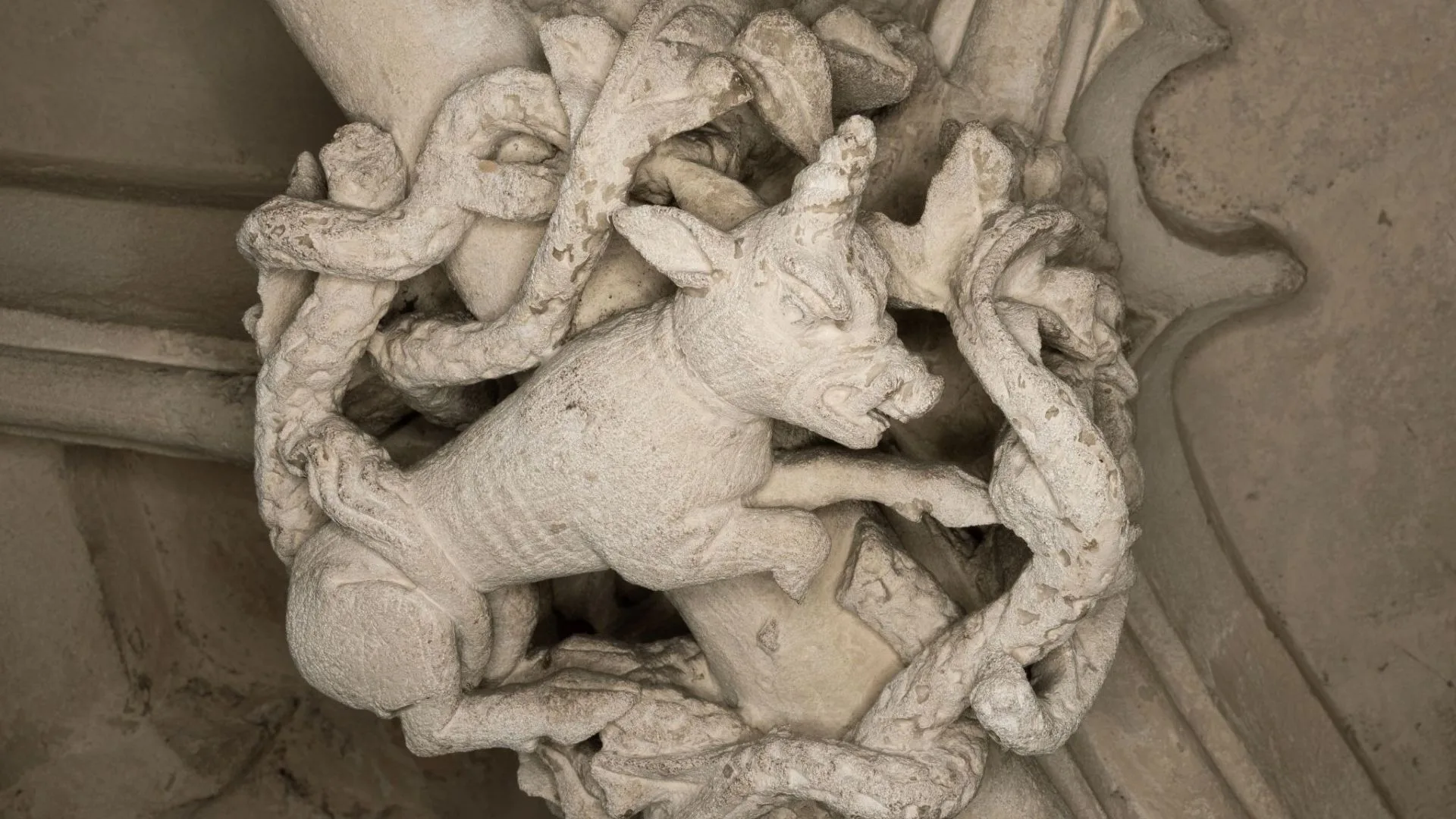
Among the most striking discoveries is a carving that had previously been described in Divinity School inventories as a “tangled calf”. Closer examination of the 3D model has shown that what was thought to be an ear is actually a single horn rising from the centre of the creature’s forehead.
The animal has been identified as a monoceros, a legendary one-horned creature known from medieval manuscripts, including the Ashmole Bestiary. Unlike the familiar unicorn, the monoceros was traditionally described as a fierce and untameable creature.
Historian Dr Duncan Taylor, who advised the ARCHiOx team on the ceiling bosses, has suggested that the image may have been deliberately associated with the unicorn, which was commonly used as a symbol of Christ. If so, the carving could have carried a particular significance in a building devoted to the teaching of divinity.
The newly recorded ceiling also brings other unusual imagery into sharper focus, including animals, human figures and scenes whose meanings may have been intended to operate on several levels.
The carvings have been interpreted as containing literary and religious references, rebuses, puns and other forms of visual wordplay. Among the examples highlighted by researchers are a squirrel hidden in a nut tree and a man wrestling a bear.
“Everyone from medieval kings to modern-day fans of Harry Potter have looked upwards in awe at the carved roof-bosses,” Dr Taylor said. The new recordings, he added, have shed light on “the messaging and meaning” of a display whose significance has often remained unclear.
The project has also revealed details of the building itself that had previously gone undocumented. Small wooden wedges used to hold plaques in place on the ceiling’s pendants have been identified at the edges of the room. Records show that the wedges were installed on the recommendation of architect Sir Christopher Wren, but the new images provide the first known visual documentation of them.
The recording process involved photogrammetry, in which hundreds of photographs taken from different positions are combined to create a detailed three-dimensional model. The approach captures the shape, colour and texture of the original, allowing researchers to inspect the resulting model digitally.
Factum Foundation recorded the Divinity School ceiling using photogrammetry and LiDAR, creating a high-resolution digital record that can also support conservation and the production of physical facsimiles.
The work is particularly significant because the previous major photographic documentation of the ceiling dates from 1914. Some details visible in those earlier photographs have since faded or disappeared, making the new digital record a valuable point-in-time record of the building.
The Bodleian Libraries and Factum Foundation have made the resulting 3D models available online, allowing members of the public to examine the carvings closely without having to look up from the floor of the Divinity School.
The project forms part of ARCHiOx, a collaboration between the Bodleian Libraries and Factum Foundation that has used advanced imaging techniques to document objects and surfaces within Oxford’s cultural collections. The Bodleian says the work has already enabled researchers to make new discoveries within its collections.
For visitors to Oxford, the Divinity School remains one of the historic spaces included in the Bodleian’s guided tours. It is also among the Oxford locations associated with the Harry Potter films.
The new recordings offer a different way of seeing a building that thousands of visitors have already looked at — by bringing its smallest and most enigmatic details within reach of the digital viewer.