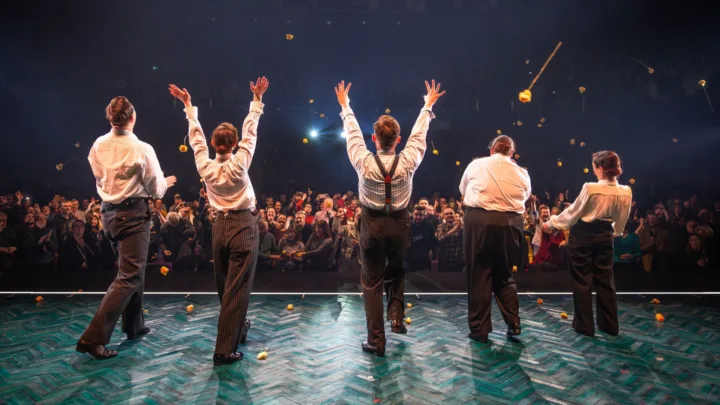
Adventurous, dynamic and daring dance company Rambert continues to take the world by storm as they announce the return of their popular dance theatre show, Peaky Blinders: The Redemption of Thomas Shelby, from 13 September to 02 November 2024.
Written by the series creator Steven Knight, with choreography and direction by Rambert’s Artistic Director Benoit Swan Pouffer, Rambert returns to stages across the UK this Autumn.
Performances will occur at Aylesbury Waterside Theatre, Liverpool Empire Theatre, Bristol Hippodrome, Festival Theatre in Edinburgh, New Theatre in Oxford, The Lowry in Salford and Sunderland Empire.
In 2025, Rambert will return to Southampton to perform at the Mayflower Theatre from 20 to 24 May, with further UK, European and International dates to be announced.
As one of the world’s most diverse dance companies, Rambert is proud to present a show that embodies the organisation’s ethos of presenting awe-inspiring, relevant and relatable work that shows new perspectives and connects with new and existing audiences.
Having been seen by over 100,000 people during its initial run, with many of these audience members seeing dance for the first time, Peaky Blinders: The Redemption of Thomas Shelby is the company’s longest and most successful touring work.
The thrilling stage adaptation captures the Peaky story, with stunning performances from Rambert’s dancers and an iconic soundtrack from a live on-stage band.
Having included an exclusive plot and characters never seen on screen, Steven Knight opens the story in the trenches of The Somme in 1916 to tell a personal story of post-war industrial Birmingham, where the Shelby family navigate the decisions that determine their fate, and Tom-my is intoxicated by mysterious newcomer, Grace.
While Tommy is building his empire, Grace is operating as an undercover agent for Special Branch on a mission to get close to the heart of Tommy’s gang. As the story unfolds, hearts are broken, and revenge is sought in a script spoken by the late Birmingham-born writer and poet Benjamin Zephaniah, who played street preacher Jeremiah Jesus in the TV series.
The band of live musicians are led by Musical Director Yaron Engler with a specially commissioned score by Roman GianArthur that includes iconic Peaky tracks from Nick Cave and The Bad Seeds, Radiohead, Anna Calvi, The Last Shadow Puppets, Frank Carter & The Rattlesnakes and Black Rebel Motorcycle Club.
The creative team for the stage production includes set design by Moi Tran, lighting design by Natasha Chivers and costume design by Richard Gellar, with production dramaturg by Kaite O’Reilly.
Acting director Kim Pearce, illusions director Filipe J. Carvalho, fight director Adrian Derrick-Palmer, props supervisor Lily Mollgaard, and intimacy director Yarit Dor, with sound design by Moshik Kop, were part of the creative team involved in the creation of the stage production.
Executive Producers for the stage adaptation are Helen Shute, Alex Darbyshire, Simon Sinek and Robin Saunders.
From stage to screen, the return of the popular show follows the success of Peaky Blinders Rambert’s Redemption of Thomas Shelby being aired on BBC 4 on Mon 01 January at 9.25pm as part of the broadcaster’s Christmas programme.
Having written and adapted the production for Rambert, Peaky Blinders writer and creator Steven Knight said: “I’m absolutely thrilled the Peaky/Rambert collaboration has been such a resounding success.
So many people came to see the show, and so many of them were new to live dance, which is why we all wanted to do this, so I’m delighted that the show is back on the road after popular demand.”
Rambert’s Artistic Director Benoit Swan Pouffer, who choreographed and directed the production, said: “As a company, we are so proud of the success of Peaky Blinders: The Redemption of Thom-as Shelby and are excited to see its return.
As a choreographer, I love that I get to tell these stories through movement and recreate these iconic characters through dance in collaboration with a talented creative team that includes Steven Knight.
Rambert is one of the world’s most diverse companies of dancers, and I’m proud that we present adventurous, dynamic and daring work that inspires audiences locally, nationally and internationally.”
Written and adapted for the stage by Peaky Blinders’ creator Steven Knight and choreographed and directed by Rambert’s Artistic Director Benoit Swan Pouffer, Peaky Blinders: The Redemption of Thomas Shelby arrives at New Theatre Oxford from Tuesday 15 October until Saturday 19 October 2024.
This show arrives at an exciting time, coinciding with filming for the upcoming Peaky Blinders film in September, and here’s some of what Steven had to say in the lead-up to the show.
How did you become connected with Rambert?
It was a gradual process because someone at the BBC suggested that we meet when we talked about doing a 12-minute dance piece as part of a Peaky Blinders festival. Rambert was brought on, and it was brilliant.
I was writing Series 5 of Peaky Blinders at the time, and so I wrote a scene where Tommy Shelby invites Rambert to his house because, in the 1930s, Rambert used to tour the country and do shows under the ethos of bringing dance to the people. In Peaky Blinders, the music, the way people move, and the way they dress is really important, so I think it really lends itself to dance.
Rambert’s Artistic Director, Benoit Swan Pouffer, and I noted that we could create a full show together. I was shocked when the company asked me to write it, but I imagined the set and the stage and wrote what I thought would be good for that.
Benoit and I started working together, and it began to snowball. We brought in some great collaborators and got really good music for it. I saw the show in rehearsals and couldn’t believe how great it was. I first saw it performed to an audience in Birmingham, and it raised the roof with standing ovations, and now it’s going all over the place.
How does the work of Rambert make you feel?
I didn’t realise how direct the relationship between dance and the audience is. I work with dialogue and plot within scenes where people act the roles, whereas in dance, it feels more subtle in the execution but more direct in the effect. An interaction between two people can be very stylised, but you get to see that very quickly, and the music continues to amplify that.
How did you meet both inspirations and visions during the collaboration process of making the work?
I wrote the script as though it was a long script without dialogue, with slight inclusion of narration.
I started off with WW1 and soldiers coming out of a tunnel and imagined how they would look and move whilst thinking about how that would make them feel, too.
The way I tend to write is quite instinctively, so I write whatever comes into my head at the time – so I just wrote it whilst imagining it through dance and music. I wrote it almost like a dream rather than a script. It felt dreamlike, not like forcing the imagination, but writing what comes to you at the time.
How did it feel trusting another creative with the keys to Peaky Blinders?
When there’s somebody as good as Benoit [Swan Pouffer], it’s a relief. It’s like giving the script to a good director, as you know they are going to take what you’ve done and enhance it.
I’m a firm believer in doing things that you haven’t done before, otherwise, it’s boring, so the idea of telling people that Peaky Blinders will be presented through dance is great.
Do you think you learnt anything from Benoit or Rambert and the art of storytelling?
Yes. I think it teaches you that sometimes words cause a jam. Instead, you can present something quite quickly in dance, and it teaches you the power of a look.
The thing about dance is that all of us are experts in it because we all live our lives in a dance. For example, if someone walks into a room – you can tell if they are in a good or bad mood because of their body language.
Dance takes that and puts it to music.
How did you come to decide that there would be a live band on stage?
The music is central to the TV series, and music is the stepping stone between the TV series and the dance piece, too.
Roman GianArthur, who did the score, absolutely got what Peaky Blinders was about. It isn’t exactly a particular style of music, as it can be folk or heavy metal, but it does need to have a certain swagger or a certain attitude to it.
In terms of the style of music, and in the words of Cillian Murphy, “There is music that is Peaky, and there is music that isn’t Peaky. You can’t always define it but you can tell when you hear it”.
Is it exciting to be bringing in a new audience with this work?
It really is, and it is one of the reasons why we decided to do it.
I’m proud that Peaky Blinders isn’t high-brow or it isn’t of a particular class – it’s a cross-section of people from different backgrounds, and so it does appeal to different people, too.
People may not always walk through a door marked ‘dance’, but they may walk through a door marked ‘Peaky Blinders’, and so it’s the idea that you can connect with new audiences by welcoming them through that setting.
Saying that, the BBC’s most popular TV show across all demographics is Strictly Come Dancing, so audiences love watching people dance. It isn’t like it’s restricted to certain people of a level of education or income, as people have been dancing for 10,000+ years.
Isn’t it great that something like this can work, and it challenges the idea that there are these rigid barriers between class and entertainment?
Do you think Peaky Blinders: The Redemption of Thomas Shelby is an accessible show?
Absolutely. It’s very accessible.
The story is clear, and we aren’t planning on baffling people. We are being as clear as we can about what’s going on, and that in itself is quite mysterious.
It ties into what Rambert’s original remit was in the 20s and 30s of taking dance to working-class people who love dance. That doesn’t come with a clause of being patronising, but I think this show does that in the true spirit of Rambert.
For me, you’re getting to see what human beings can do; the way the dancers move and the way they interact as they throw themselves into it. I think it’s incredible that you can see human bodies pushing themselves to the limit to tell a story – it’s brilliant.
If you could describe Peaky Blinders: The Redemption of Thomas Shelby in three words, what would they be?
Romantic, tragic and uplifting.
Do you have a favourite moment in Peaky Blinders: The Redemption of Thomas Shelby?
Any moment when it’s Tommy and Grace together is brilliant.
What do you want audiences to feel when they engage with the dance theatre show?
It’s a live experience, and that’s one of the things that I really like about it as, in comparison, television isn’t a communal experience.
What tends to happen is that people watch Peaky Blinders, and then they get on social media, so the communal experience happens on screens.
If you get people in a room together, and you get them all in the same space listening to and watching the same things, it’s just totally different. For me, it’s more satisfying, I suppose, because audiences get their reactions out of their system.
If you go into a room and watch the work, and you hear the music, and you are part of a standing ovation, you have a beginning, middle and end to that experience. You can then take it out into the cold and talk about that experience together.