Oxfordshire-based space communications company Archangel Lightworks has successfully completed field trials of its TERRA-M system — described as the world’s smallest deployable operational optical ground station — demonstrating secure, high-speed laser communications with satellites in low Earth orbit.
The multi-day trials took place in the Mediterranean region earlier this month and were funded by the UK’s Defence Science and Technology Laboratory. During the tests, data was securely transferred between the TERRA-M and a satellite using the U.S. Space Development Agency laser communication standard. Multiple satellite passes were conducted to validate the reliability and resilience of the system.
The successful demonstration was welcomed by Liz Lloyd, who praised the company for helping position the UK at the forefront of next-generation space communications technology.
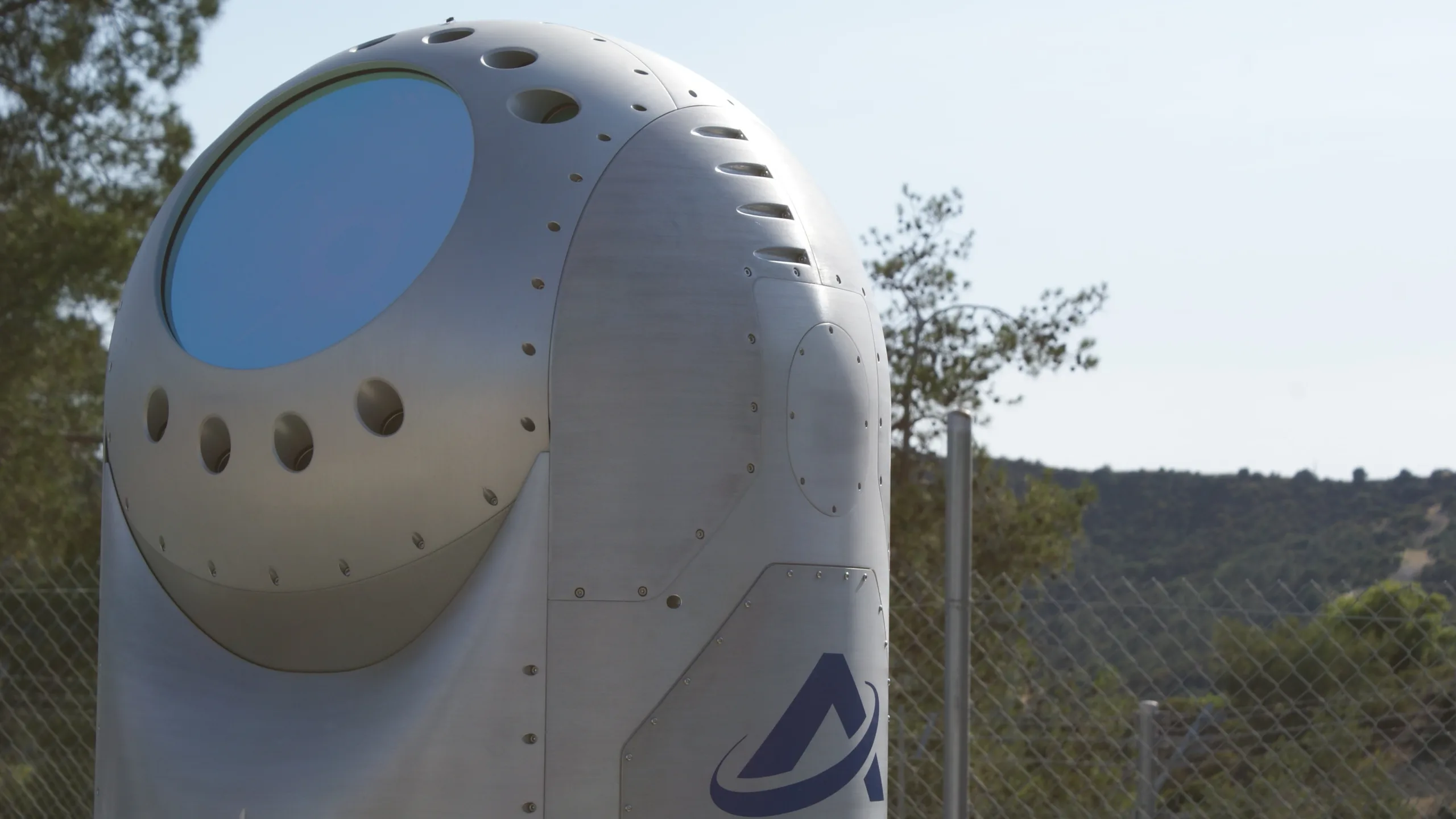
The TERRA-M has been designed as a compact, rapidly deployable alternative to traditional optical ground stations. With an optical head standing just 1.1 metres tall and 0.7 metres in diameter, the system is a fraction of the size of conventional infrastructure and does not require a dedicated dome or standalone building.
Its portability means the unit can be transported by light vehicle or aircraft and deployed quickly in remote or temporary locations, including rooftops and edge-network environments where communications infrastructure may be limited.
Richard Johanson, CEO of Archangel Lightworks, said the trials demonstrated the system’s unique capability to provide secure and rapid satellite communications while remaining small enough to be deployed wherever needed.
He added that the company is working towards resilient, large-scale deployable networks of optical ground stations as global demand for space-based connectivity and information services continues to accelerate.
Space Minister Liz Lloyd said the successful trials highlighted British innovation in advanced space technology and showed the UK’s growing leadership in laser communications infrastructure.
She said investment in homegrown capability would strengthen national security, support economic growth and create opportunities across the country, adding that the Government was proud to support the company’s progress.
Laser communications are expected to become an increasingly important part of future satellite infrastructure, offering secure, high-capacity alternatives to traditional radio-based transmission systems. Applications include satellite internet backhaul, Earth observation data transfer and support for deep-space missions such as Artemis program.
The technology also has significant defence and resilience applications, helping reduce reliance on vulnerable terrestrial and subsea communications cables. Archangel Lightworks said deployable optical ground infrastructure could also help improve connectivity for underserved communities and support the growth of orbital data centres and other space-based computing networks.
The TERRA-M has been developed with a modular architecture designed to support interoperability with a broad range of laser communication standards and terminals.
Archangel Lightworks recently raised $13.5 million (£10 million) in an oversubscribed Series A funding round, bringing the company’s total funding to date to $20 million. Investors include Santander Alternative Investments, Blackfinch Ventures, Oxford Science Enterprises and Oxford Capital.
The company is also supported by the UK Space Agency, the UK Government’s Department for Science, Innovation and Technology, and the Ministry of Defence. It has also signed memoranda of understanding with companies including Starcloud and Omantel.