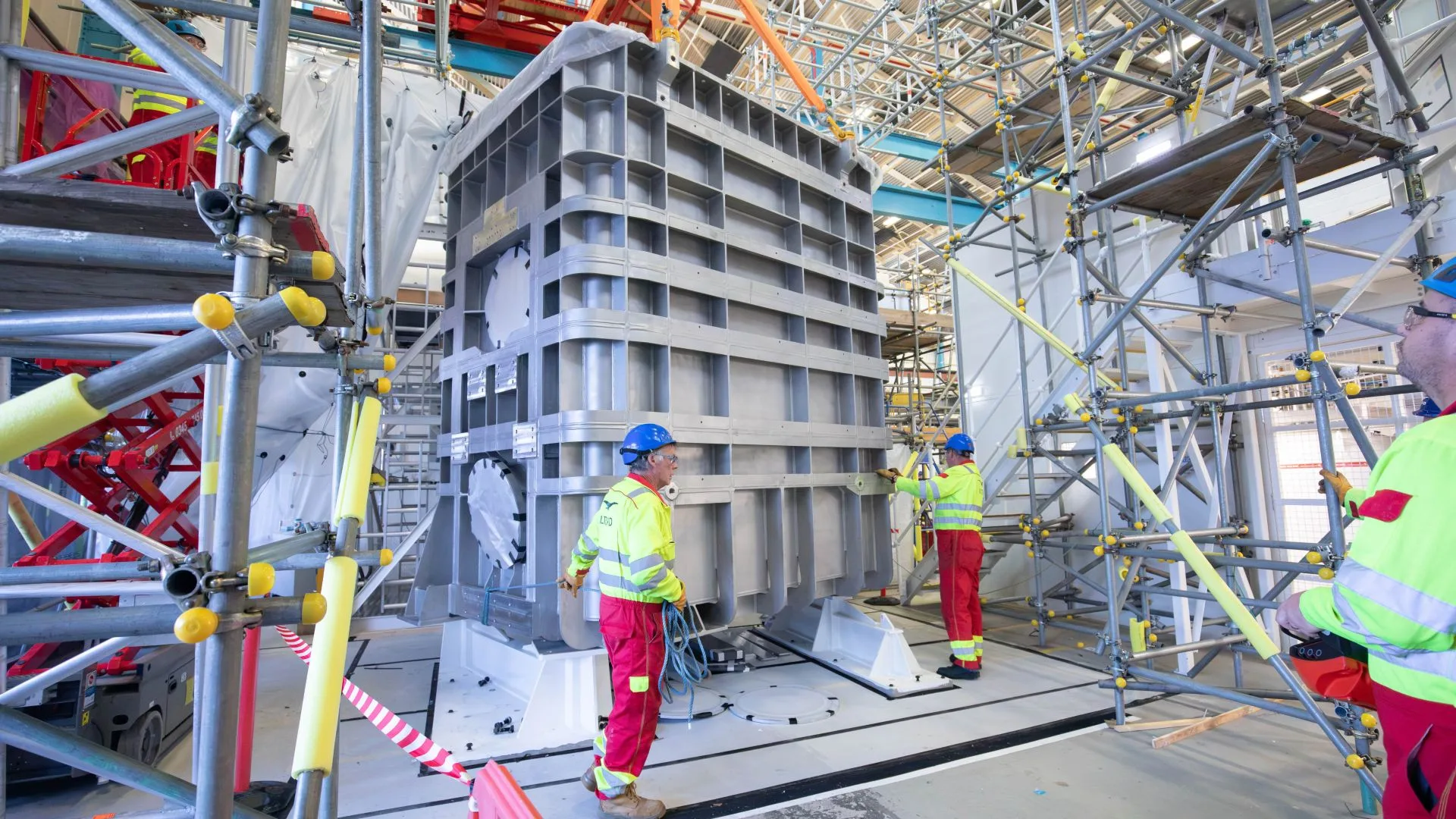
Engineers at the UK Atomic Energy Authority (UKAEA) have installed a 12-tonne component at Culham Campus as part of a major upgrade to one of the UK’s leading fusion research machines.
The double beam box vessel has been manoeuvred into position for the MAST Upgrade facility, where it will accommodate two additional neutral beam injectors. The equipment will double the machine’s neutral beam heating power from 4.4 megawatts to 8.8 megawatts.
Neutral beam injectors heat plasma by firing high-energy neutral atoms into it, enabling scientists to investigate the extreme conditions required for nuclear fusion. With the additional equipment, researchers expect to explore plasma temperatures of up to 60 million degrees Celsius, compared with the current 30 million degrees.
The increased heating capacity will allow scientists to investigate the stability of higher-pressure plasmas and examine how the machine’s exhaust system performs under more demanding conditions. The findings are expected to contribute to research into future fusion power plants, including the UK’s proposed prototype STEP facility.
Andrew Thornton, Head of MAST Upgrade Operations at UKAEA, described the installation as a significant step forward for the research programme. He said:
“The lift of the double beam box is a huge step forward for MAST Upgrade. By doubling our heating power, we will explore plasma conditions we simply couldn’t reach before.
“We will be able to study the stability of higher-pressure plasmas while testing how the MAST Upgrade exhaust system copes with these hotter, higher-performance plasmas.
“These are crucial questions for STEP and future fusion power plants. It’s also a great example of the engineering skill and collaboration across UKAEA’s science and engineering teams.”
The installation forms part of a wider programme of engineering upgrades at MAST Upgrade. Work also includes a new electron Bernstein wave microwave heating system, the repurposing of power supply equipment from the former Joint European Torus (JET) facility, and the installation of additional components for the neutral beam injection system.
A new cryopump is also being manufactured for installation inside the double beam box, where it will help control pressure within the vessel.
Once completed, the double beam box vessel, including its lid, will weigh approximately 15 tonnes. It has a volume of 20 cubic metres and is constructed from 316L stainless steel, selected for its strength, durability, corrosion resistance and suitability for the high-vacuum conditions required by fusion research.
UKAEA expects the major hardware to be manufactured and installed inside the vessel by the end of autumn 2027. The vacuum-tight system will then be commissioned ahead of scientific experiments scheduled to begin in 2028.