A business in Banbury is calling for greater attention to loft insulation and raised boarding as households face continued pressure from energy costs and the government prepares to deliver its Warm Homes Plan.
Amazing Lofts, founded in 2022 by friends Kevin Baker and Richard Blane, made the case for raised loft boarding during a visit from Banbury MP Sean Woodcock, who was shown how the system is installed and how it can allow householders to use their loft space without compressing insulation.
The company argues that compressed insulation can significantly reduce its effectiveness, particularly when household storage is placed directly on top of mineral wool.
The issue has wider implications for home energy efficiency. Loft insulation is intended to reduce heat escaping from living spaces, but its performance can be compromised if it is compressed or installed below the recommended depth.
Mr Baker said millions of homes still have insulation that falls short of modern standards and urged homeowners to check their lofts before the colder months arrive.
“Every homeowner should prioritise checking if their loft insulation is sufficient before the winter starts to bite,” he said.
Amazing Lofts estimates that inadequate loft insulation can cost households as much as £370 a year in additional energy costs. The figure is a company estimate and will vary according to the property, insulation, heating system and household energy use.
The company is also highlighting research into the impact of compressed insulation. The National Physical Laboratory has previously examined the relationship between insulation thickness and thermal performance, although the precise savings available to individual households depend on a range of factors.
A question for the Warm Homes Plan
The campaign comes as the government seeks to improve the energy efficiency of homes through its Warm Homes Plan.
Dave Raval, director of the National Warm Homes Council, said the long-term performance of insulation should be considered alongside the initial installation.
The council has developed a raised loft system using recycled plastic, designed to create a storage platform above insulation rather than placing boards directly onto it.
“Raised loft boarding protects insulation from compression,” Mr Raval said, arguing that boarding above the insulation should be considered when energy-efficiency improvements are installed.
For homeowners, the question is a practical one: how to make loft space useful for storage without undermining the very insulation intended to make a property more energy efficient.
MP gets hands-on in Banbury
Mr Woodcock visited Amazing Lofts in Banbury and took part in installing a raised boarding system.
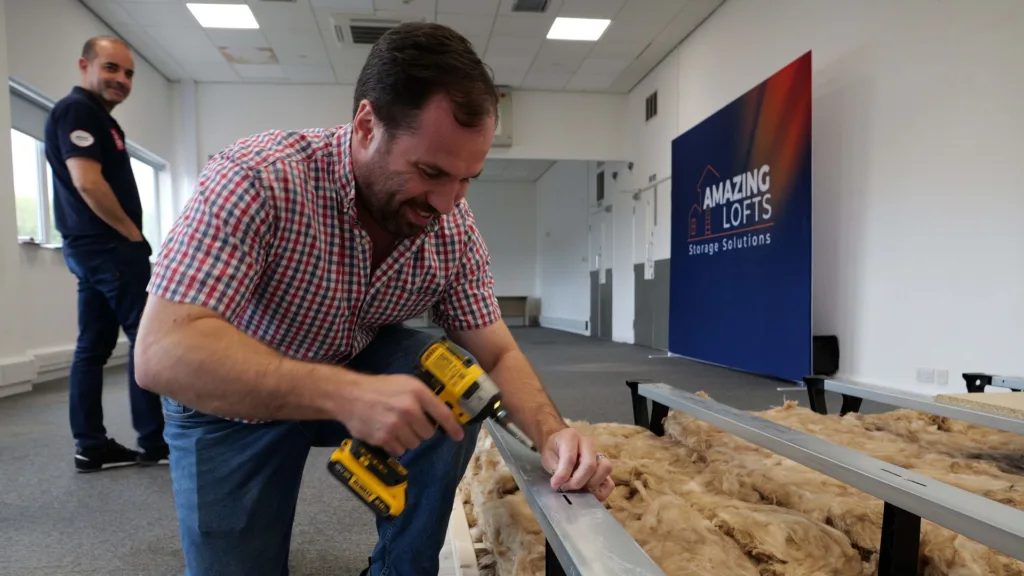
He said the visit demonstrated how relatively straightforward measures could contribute to improving the energy efficiency of homes.
“Seeing the straightforward difference that proper, uncompressed insulation makes highlights how targeted local solutions can help residents manage energy costs,” he said.
The visit also gives the Banbury-based company an opportunity to press its case for changes to the way government-backed energy-efficiency improvements are designed and delivered.
For households preparing for another winter of high energy costs, the message is less about a particular product than a basic principle: insulation only works as intended if it is installed and maintained correctly.
Before investing in loft boarding or insulation, homeowners should check the condition and depth of their existing insulation and seek advice from a suitably qualified installer.